
Online
Curriculum and Instruction
Master of Science in Education (MSEd) in Curriculum and Instruction

concentrations

Choose a Career-Focused Concentration
Step into leadership roles and meet the growing diversity of classrooms — choose from six concentrations to deepen your learning in a focused area.
The online MSEd Curriculum and Instruction program does not lead to licensure in the state of Indiana or elsewhere. Through a separate application process, the English Language Learning concentration may offer optional licensure preparation for teachers in Indiana. Contact the College of Education Office of Teacher Education and Licensure (OTEL) before continuing with the program application if you have questions regarding licensure.
Provide high-quality language and content-area instruction for students learning English as an additional language (one of the fastest-growing and most diverse populations) in the U.S. and around the world. Through a separate application process, this concentration offers optional licensure preparation for teachers in Indiana or an optional graduate certificate. Follow the below links to learn more about these additional credentials:
English Language Learning Graduate Programs
Teaching English Language Learners (TELL) Graduate Certificate
English Language Learning Licensure
This is a non-licensure program. Contact the College of Education Office of Teacher Education and Licensure (OTEL) before continuing with the program application if you have questions regarding licensure or contact your state Department of Education about how this program may translate to licensure in your state of residence.
Develop knowledge and skills for teaching STEM disciplines through the integration of engineering and technology design, in problem- and project-based contexts. When you complete this concentration, you will understand the philosophical foundations of integrated STEM education and be able to develop, deliver, and assess engaging K-12 integrated STEM educational experiences. Through a separate application process, this concentration offers an optional graduate certificate. Follow the below link to learn more about this additional credential:
K-12 Integrated STEM Education Graduate Certificate
This is a non-licensure program. Contact the College of Education Office of Teacher Education and Licensure (OTEL) before continuing with the program application if you have questions regarding licensure or contact your state Department of Education about how this program may translate to licensure in your state of residence.
Serve gifted, creative and talented students while learning a strengths-based talent-development model that helps all students realize their full potential.
Gifted, Creative and Talented Studies Graduate Certificate (non-licensure)
This program does not lead to licensure in the state of Indiana or elsewhere. Contact the College of Education Office of Teacher Education and Licensure (OTEL) before continuing with the program application if you have questions regarding licensure.
Broaden your knowledge and practice in teaching and learning mathematics as you develop your expertise in mathematics and in the methods of teaching mathematics to meet the needs of diverse learners. Courses emphasize connections between K-16 mathematics content and effective, research-based instructional strategies.
This is a non-licensure program. Contact the College of Education Office of Teacher Education and Licensure (OTEL) before continuing with the program application if you have questions regarding licensure, or contact your state Department of Education about how this program may translate to licensure in your state of residence.
Take on a leadership role in curriculum and training, and prepare professionals from K-12 and related environments to improve students’ learning experiences. Offers an optional graduate certificate in instructional design.
Instructional Design, Online Graduate Certificate
This is a non-licensure program. Contact the College of Education Office of Teacher Education and Licensure (OTEL) before continuing with the program application if you have questions regarding licensure, or contact your state Department of Education about how this program may translate to licensure in your state of residence.
In the Special Education (SPED) degree concentration, students explore inclusive education practices and gain a deeper knowledge of the policies that govern the responsibilities of schools, teachers and providers who serve individuals with exceptionalities. Courses in this concentration specifically support participants in the diverse reading needs of exceptional students and learning how their practices as teachers, administrators or service providers can adjust to meet these needs through adaptive curriculum, differentiated instruction and other strategies.
Applications for this concentration are currently not being reviewed.
This is a non-licensure program. Contact the College of Education Office of Teacher Education and Licensure (OTEL) before continuing with the program application if you have questions regarding licensure, or contact your state Department of Education about how this program may translate to licensure in your state of residence.

Watch Our Virtual Info Session Now!
Learn about our online MS in Education in Curriculum and Instruction degree and the support you will have with you along the way.
Courses

Gain New Curriculum Skills Critical to Classroom Success
Purdue’s curriculum and instruction program equips you with advanced skills and experiences in evaluating, creating, and teaching curriculum. As a graduate, you’ll be able to understand, conduct and communicate research to your colleagues, local policymakers, administrators and the community to create successful learning opportunities for your students.
Graduates Can:
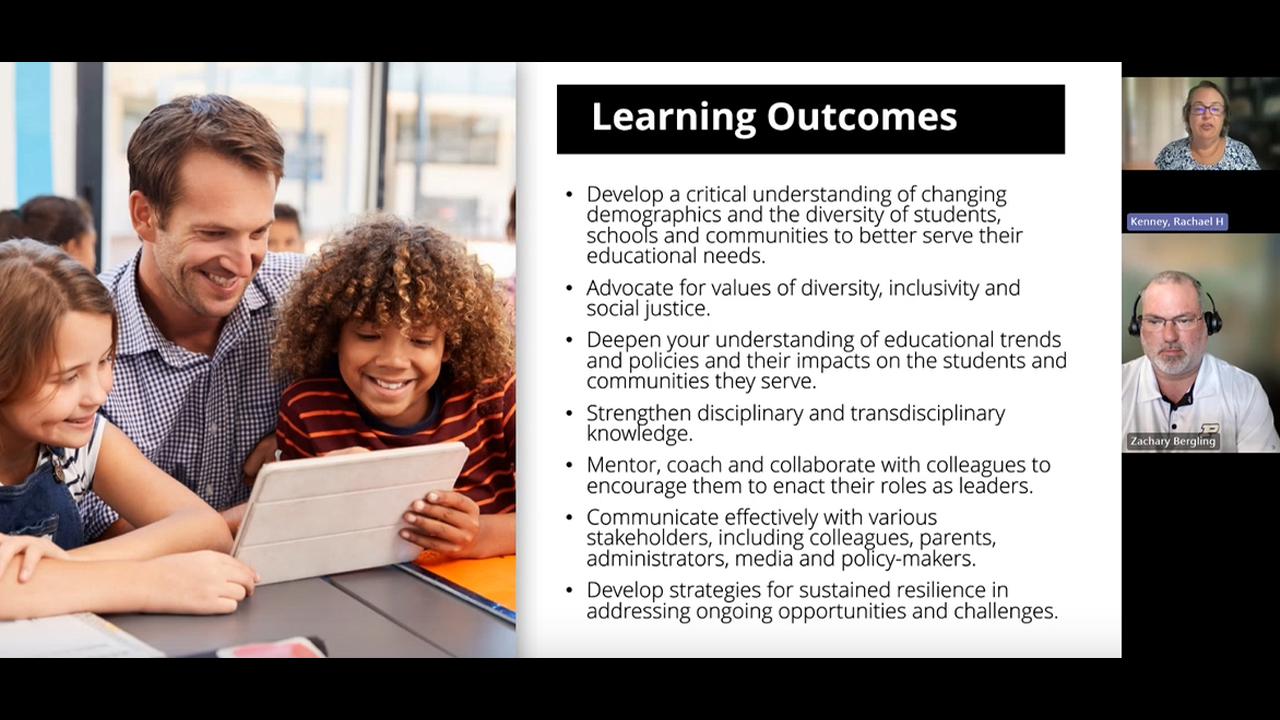
- Develop a critical understanding of changing demographics and the diversity of students, schools and communities to better serve their educational needs.
- Advocate for values of diversity, inclusivity and social justice.
- Deepen your understanding of educational trends and policies and their impacts on the students and communities they serve.
- Strengthen disciplinary and transdisciplinary knowledge.
- Mentor, coach and collaborate with colleagues to encourage them to enact their roles as leaders.
- Communicate effectively with various stakeholders, including colleagues, parents, administrators, media and policy-makers.
- Develop strategies for sustained resilience in addressing ongoing opportunities and challenges.
Careers

Create a Flexible Career in Education
When you look at the employment statistics for positions in education that demand a graduate degree like the master’s in curriculum and instruction, you’ll see a strong focus on helping all students thrive within their academic abilities.
- 857,600 new educational instruction and library jobs are projected per year from 2022 to 20321
- $66,490 average salary of instructional coordinators with a master’s degree1
- 15% increase in average annual salary for professionals who hold a master’s degree2
Additional Details
1Bureau of Labor Statistics, U.S. Department of Labor. Occupational Outlook Handbook, Educational Instruction and Library Occupations. Sept. 6, 2023. Retrieved on Apr. 1, 2024, from https://www.bls.gov/ooh/education-training-and-library/home.htm.
2Bureau of Labor Statistics, U.S. Department of Labor. Employment Projections, Education pays. Sept. 6, 2023. Retrieved on Apr. 1, 2024, from https://www.bls.gov/emp/chart-unemployment-earnings-education.htm.
Admissions

Admissions
Admissions decisions are based on individual experience and the applicant’s fit with the program. We recommend that all applicants speak to an enrollment counselor to verify eligibility and document accuracy in applying for the program.
Below are the materials required for this application. Visit the Office of Graduate Students and Postdoctoral Scholars (OGSPS) website for more information about the requirements below.
- A bachelor’s degree from a regionally accredited institution
- An updated resume
- Two Statements
- Academic Statement of Purpose
- Personal History Statement
- Official transcripts from all universities attended, including transfer credits*
- (2) professional letters of recommendation from individuals familiar with your abilities
- An application fee of $60 ($75 for international students)
- 12 hours of previous coursework in science and/or mathematics (STEM Concentration Only)
This online program has rolling admission. Applications must be fully complete and submitted (including all required materials) and all application fees paid prior to be considered and reviewed.
*Coursework used to satisfy the requirements of a conferred master’s degree from an institution other than Purdue may not be used as transfer credit.
In addition to the admission requirements noted on the first tab, international students must also provide the following information.
- Official transcripts from all universities attended in the original language as well as English translation for transcripts and diplomas not in English.
- An application fee of $60 ($75 for international students)
- International applicants must meet English Proficiency Requirements set by the Purdue Office of the Vice Provost for Graduate Students and Postdoctoral Scholars
We recommend that all applicants speak to an enrollment counselor to verify eligibility and document accuracy before applying for the program. To schedule your phone interview, call 877-497-5851.
Once you have connected with an enrollment counselor, you are ready to complete the online application.
If you have any questions about filling out the application, contact us online or call us at 877-497-5851 to speak with an admissions advisor.
Send All Other Application Materials To:
Purdue University Online Programs Admissions Processing Center
851 Trafalgar Court, Suite 420
West Maitland, FL 32751
| Semester | Priority Application Deadlines* |
|---|---|
| Spring | December 1 |
| Summer | April 1 |
| Fall | August 1 |
*Applications submitted after the priority deadline will still be considered.
Start Your Giant Leap with One Small Step
Cost

Program Costs
| Tuition* | Indiana Resident | Non-Indiana Resident |
|---|---|---|
| Tuition Rate | $381.20 | $601.20 |
| PO Infrastructure Fee (per credit hour) | $18.80 | $18.80 |
| Digital Education Fee (per credit hour) | $50.00 | $50.00 |
| Total Cost Per Credit Hour** | $450.00 | $670.00 |
| Total Credit Hours | 30 | 30 |
| Total Program Cost | $13,500.00 | $20,100.00 |
Additional Information
*Tuition and fees are charged on a per credit hour basis and are subject to annual increases. Annual increases may change the total program cost. Purdue faculty and staff fee remissions may not be applied to the online MSEd in Curriculum and Instruction program.
**The cost of attending Purdue varies depending on where you choose to live, enrollment in a specific program or college, food and travel expenses, and other variables. The Office of the Bursar website shows estimated costs for the current aid year for students by semester and academic year. These amounts are used in determining a student’s estimated eligibility for financial aid. You can also use our tuition calculator to estimate tuition costs.
Licensure

Licensure Information
This program does not lead to nor result in an educator license within or outside the State of Indiana. For licensure inquiries contact the College of Education, Office of Teacher Education and Licensure (OTEL).
Testimonials
Relevant, rigorous, and reflective — this program truly helped me grow as a curriculum developer and school leader, inspiring innovation in my professional practice. As an overseas student, I found the asynchronous format incredibly beneficial, offering flexibility without compromising the program’s quality, even in an online setting.
Jon Jason M. Yogawin
Head, International Curriculum Section

I am grateful for the opportunity to hone my skills in educational technology and instructional design. The faculty is extremely knowledgeable and eager to help. I would recommend the program to anyone.
Ethan Crisp
Teacher

This program provided me relevant and recent best practices in teaching English Language Learners. The flexibility of the online program paired with the expertise and kindness of the faculty make this program the best choice for any teacher currently practicing in the classroom – can’t recommend enough!
Liesel Woxland
High School Life Science Teacher

The professors and coursework through C&I Program has helped me grow as a professional and has helped me achieve my career goals.
Paola Ruiz
Instructional Coach

The professors and colleagues that I met throughout this program were the absolute best; everyone wanted to be involved and learn from one another. Likewise, I am very thankful for the program’s flexibility and affordability; I was able to balance the program with my other responsibilities as a husband and working professional. Purdue made this possible. Boiler Up!
Braden Vorhees
School Counselor

I really enjoyed working with all of my teachers and recomend this program to any and all who are willing to put in the work. This program is built to help student succeed, however, it is also built to let you grow in your own way. What you put into it will be what you get out of it
Abigail Badger
Fifth Grade Teacher

program FACULTY
Learn From the Experts
Explore how Purdue’s faculty for the online MSEd in Curriculum & Instruction can prepare you to help all students learn.
Frequently asked questions
Yes! Nearly all students complete the program while working full time. The academic experience varies by student; however, we generally recommend that students plan to spend 15-25 hours per week for each 3-credit course.
No. Qualified applicants have various backgrounds within curriculum development, like teachers, school social workers, and administrators.
Master of Science in Education (MSEd) in Curriculum and Instruction with a concentration (non-licensure) based on the program of admission:
- English Language Learning
- Integrated STEM
- Gifted, Creative, and Talented Studies
- Mathematics Education
- Educational Technology
- Special Education Non-Licensure
This information will be listed on the transcript, and the diploma states the degree objective.
Purdue University’s online programs are just as rigorous and challenging as their on-campus counterparts. The main difference is the online format, which allows you the convenience to earn your MSEd degree from anywhere in the world without temporarily relocating to complete a residential program
Both on-campus and online programs earn the same diploma, and online students are also invited to participate in the graduation ceremony on campus upon program completion.
Coursework in the program is asynchronous, meaning that there are not specific times that you need to be in the course. However, interaction with your instructor and peers is a major component of our classes. As an online student at Purdue University, you’ll log into a virtual online classroom interface that includes areas for assignments, discussions, and more. Just like in a traditional classroom, you’ll complete coursework and interact with your instructor and classmates, but it will all be online. You can access and work on your coursework at any time—you just need to complete your assignments according to the schedule posted by your professor.
As an online student, you will have access to a multitude of support resources when you need help or guidance, starting with new student orientation to familiarize yourself with the online learning environment. Other services include a designated student services coordinator, help desk for technical issues, financial aid advisors and more.
Yes, if you are a degree-seeking student and meet the financial aid citizen requirements, you may be eligible for the Stafford and/or Graduate PLUS loan programs.
Yes. Students are always encouraged to visit campus and experience all that Purdue has to offer. For more information, visit Purdue’s Visitor Information website.